- Definition:
- the "strong" calibration of a camera is the
computation of the equations of the fonction linking each 3D point in a
3D axis system to a point in a 2D plane in an image axis system. [ATRM89],
[Beyer92], [TaGa94].
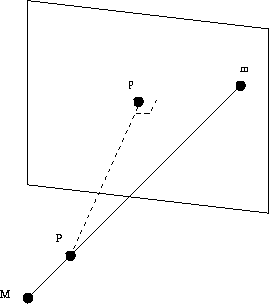
- The model of the camera is a plane, called
image plane, and a center of projection, or optical center. The image m
of a 3D point M is the intersection of the image plane with the line passing
through M and the optical center P. This line is called a projection ray.
- extrinsic parameters
- position and orientation of the camera in space (that is, position of the optical center and orientation of the image plane in space)
- intrinsic parameters
- pixel dimensions,
- focal distance, (distance of the optical center to the image plane)
- position of the principal point on the image (orthogonal projection of the optical center onto the image plane)
- the model
- the pinhole model
- the parameters
- X0, Y0 and Z0, the camera position in space;
- theta, phi and psi, the camera orientation in space;
- f/dx and f/dy the quotients of the focal distance divided by the pixel dimensions (see previous remark);
- Px and Py, the position of the principal point in the image.
- the input
- 3D points from a calibration grid
- the output
- the images of these 3D points
By using the pinhole model, two sets of parameters can be distinguished:
The "strong" calibration can be seen as a parameter estimation problem defined as follows: